In 2026, the software development landscape is undergoing its most radical transformation since the advent of the cloud. The catalyst is Artificial Intelligence, which has evolved from a simple coding assistant into a sophisticated engine driving the entire Software Development Lifecycle (SDLC).
For software companies, this shift is significantly reducing operational overhead; for consumers, it is translating into a new era of digital products that are cheaper, faster, and more reliable than ever before.
{/* Stat callout - HIGHLIGHTED GRID */}with AI-powered tools
PoC stage costs
was spent on boilerplate
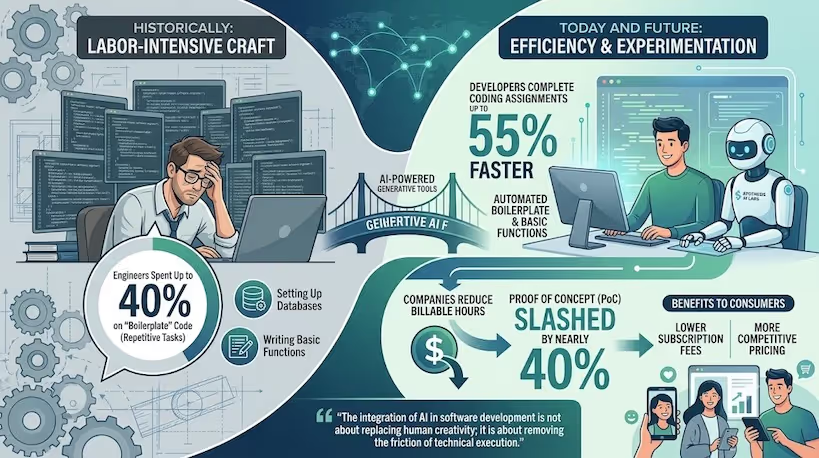
Historically, software development has been a labor-intensive craft. Engineers spent up to 40% of their time on "boilerplate" code — repetitive tasks like setting up databases or writing basic functions. Today, AI-powered generative tools have automated these tasks, allowing developers to complete coding assignments up to 55% faster.
By reducing the billable hours required to build an application, companies are slashing the cost of "Proof of Concept" (PoC) stages by nearly 40%. This cost efficiency allows startups and enterprises alike to experiment with more ideas without the fear of massive financial loss — eventually passing those savings down to consumers through lower subscription fees and more competitive pricing.
As development companies leverage these tools to reduce their "burn rate," they are reinvesting those savings into innovation. The question clients should be asking their software partners is no longer simply "can you build this?" — it is "are you building with the tools and thinking that will still be relevant in three years?"
For the consumer, the result is a digital world that works as intended. We are moving away from an era where users were "beta testers" for unfinished products, and toward a future where software is a stable, affordable, and rapidly evolving utility.