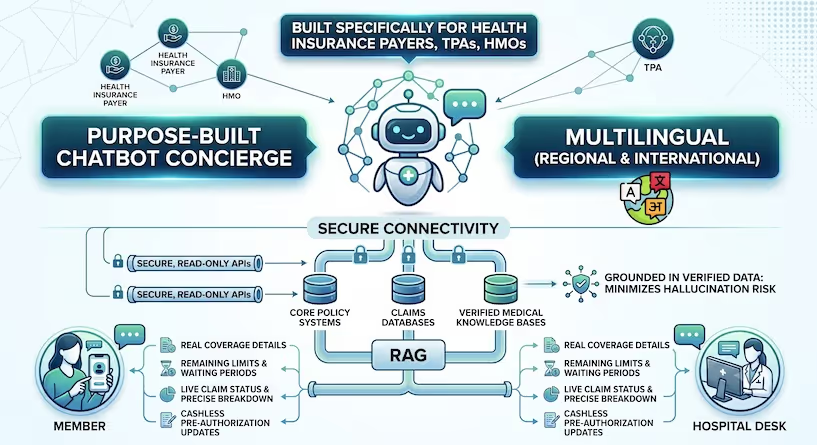
Health insurers are under pressure to deliver faster decisions while keeping errors to a minimum. Traditional, paper‑heavy workflows often lead to delays, duplicated effort, and costly mistakes. Recent advances in artificial intelligence are changing that landscape, offering a way to automate routine tasks, spot inconsistencies, and learn from each transaction. This article explores the practical ways AI improves health insurance claims, focusing on real‑world benefits rather than hype.
Understanding AI Claims Processing
AI claims processing refers to the use of machine‑learning models, natural‑language processing (NLP), and rule‑based engines to evaluate, route, and settle insurance claims. Unlike simple automation that follows a fixed script, AI can interpret unstructured data—such as physician notes or scanned documents—and make decisions that previously required human judgment.
From Data Ingestion to Decision
When a claim is submitted, AI first extracts relevant fields (patient ID, procedure codes, dates of service) using optical character recognition (OCR) and NLP. The extracted data is then compared against policy rules, historical claim patterns, and fraud‑detection models. If the claim meets all criteria, the system can approve it automatically; if not, it flags the case for human review.
Key Benefits for Health Insurance Automation
Automation powered by AI delivers measurable improvements across several dimensions of the claims lifecycle.
Reduced Turnaround Time
By handling routine submissions end‑to‑end, AI can cut processing time from days to minutes. Faster payouts improve member satisfaction and strengthen relationships with healthcare providers.
Lower Operational Costs
Automation reduces the need for repetitive manual entry, allowing staff to focus on complex cases that truly require human expertise. This shift can lower labor expenses and free up resources for higher‑value activities such as customer outreach.
Scalable Workflows
AI models can scale instantly to handle spikes in claim volume—such as during flu season—without the need for temporary hires. The same infrastructure supports growth across new product lines or geographic markets.
How AI Enhances Claim Accuracy
Accuracy is a cornerstone of trust in health insurance. Errors can lead to overpayments, denied benefits, or compliance breaches. AI contributes to claim accuracy in several ways.
Intelligent Validation
AI cross‑checks each claim against the insurer’s policy database, medical coding standards, and provider contracts. Mistakes such as mismatched procedure codes or incorrect billing amounts are caught before the claim is settled.
Pattern Recognition for Anomaly Detection
Machine‑learning algorithms learn typical claim patterns for a given provider or member. When a new claim deviates significantly—perhaps indicating a duplicate submission or an outlier cost—the system raises an alert for further investigation.
Continuous Learning
Every approved, denied, or corrected claim feeds back into the model, refining its predictions over time. This feedback loop helps the system adapt to changes in coding practices, new medical procedures, or evolving regulatory requirements.
Implementation Considerations
Adopting AI claims processing is not a simple plug‑and‑play project. Insurers need to address technical, organizational, and compliance factors.
Data Quality and Governance
AI models rely on clean, well‑structured data. Investing in data cleansing, standardization, and robust governance policies is essential to avoid garbage‑in‑garbage‑out outcomes.
Integration with Legacy Systems
Most insurers operate on legacy policy administration platforms. Seamless integration—often via APIs or middleware—ensures that AI can access real‑time policy data and push decisions back into existing workflows.
Regulatory and Ethical Oversight
Health data is highly regulated. Any AI solution must comply with privacy laws such as HIPAA and demonstrate transparency in decision‑making. Maintaining an audit trail of AI‑generated actions helps meet regulatory scrutiny.
Future Outlook
As AI models become more sophisticated, we can expect deeper integration with other emerging technologies. For example, combining AI with blockchain could provide immutable claim records, while conversational AI assistants might guide members through the submission process in real time.
Ultimately, the goal is not to replace human expertise but to augment it. By handling routine, high‑volume tasks, AI frees claims adjusters to focus on nuanced cases that benefit from clinical judgment and empathy.
Practical Conclusion
AI claims processing and health insurance automation are already delivering faster, more accurate payouts while reducing operational costs. Insurers that invest in clean data, thoughtful integration, and ongoing model monitoring will see tangible improvements in claim accuracy and member experience. The technology is mature enough to act now, and the competitive advantage will belong to those who adopt responsibly.
Related on ZAAX:
Enterprise Generative AI Development & Production AI Engineering
Health Insurance Claims Processing Software
Assure Tech Pro — AI-Powered Health Insurance Platform