A customer asks your chatbot a simple question — what's covered, what's the deductible, when does the claim get paid — and the bot answers instantly, fluently, and confidently. The only problem: the answer is wrong. Nobody flags it, because it doesn't look wrong. It reads exactly like every correct answer the bot has ever given.
That is an AI hallucination, and for any business running AI in front of real customers — especially in regulated, high-stakes domains like health insurance — it's the single biggest risk standing between a chatbot pilot and a chatbot you can actually trust in production.
What Is a Chatbot?
A chatbot is software that carries on a conversation with a person through text or voice, standing in for a human agent on tasks like answering questions, looking up information, or guiding someone through a process. Early chatbots followed rigid, pre-written decision trees — useful for simple, predictable questions, but brittle the moment a customer phrased something unexpectedly.
Modern chatbots are built on large language models (LLMs): AI systems trained on enormous volumes of text that let them understand natural, conversational language and generate fluent, human-like responses on the fly, rather than picking from a fixed script. That flexibility is what makes today's chatbots genuinely useful for open-ended customer support — and it's also exactly what creates the hallucination risk, because a model that can generate almost any plausible-sounding sentence doesn't automatically know which of those sentences are true.
What Is an AI Hallucination?
An AI hallucination is when a model produces information that sounds accurate and is delivered with total confidence, but is factually wrong or entirely made up. Ask an LLM for a policy detail, a legal precedent, or a product specification, and every so often it will answer with something fluent, specific, and false.
This happens because of how these models actually work. An LLM generates text by predicting the most statistically likely next word based on patterns learned from its training data — it isn't looking anything up in a verified database, and it has no built-in mechanism to check whether what it just said is true. Most of the time, the statistically likely answer is also the correct one. Occasionally, especially when a question touches something the model wasn't specifically trained on — a particular policy form, a specific jurisdiction's rules, an edge case in your business logic — it fills the gap with something that merely sounds right.
The distinction between a hallucination and an ordinary software bug matters enormously. A broken system throws an error; everyone knows something failed. A hallucinating AI system succeeds, in the sense that it returns a well-formed, professional, confident answer — with nothing about the output itself indicating that it's fabricated. Nobody catches it until someone happens to check the answer against the actual source document, and by then the customer may have already acted on it.
This stopped being a theoretical risk once AI moved from pilot projects into genuine day-to-day customer interaction. Two real, documented cases illustrate exactly what's at stake:
- Air Canada was ordered by a tribunal to honor a bereavement-fare discount its own chatbot had invented — one that never actually existed as company policy. The tribunal's ruling was unambiguous: a company is responsible for what its chatbot tells customers, full stop.
- In Mata v. Avianca, a law firm submitted a legal brief built in part on six court cases that turned out not to exist — fabricated by an AI tool and never independently verified before filing. The firm was sanctioned by the court.
Neither of these companies was reckless. They were doing what most businesses adopting AI are doing right now — and the wrong answer still reached the customer, and still became the company's problem to own.
Why This Is Especially Dangerous in Insurance and Healthcare
Most industries can absorb the occasional AI error as acceptable noise. Health insurance largely cannot, for a few concrete reasons:
- Regulatory accountability is document-level. Regulators expect adverse coverage decisions and claim outcomes to trace back to actual, documented facts — not to something an AI model generated on the fly. A hallucinated policy provision creates a paper trail that directly contradicts the real record.
- Policy language is precise by design. Waiting periods, sub-limits, co-payments, and exclusions mean something very specific under a given policy. A model that sounds fluent in insurance language isn't the same as one that actually knows which limit applies to which member's specific plan.
- The regulatory environment is actively tightening. Multiple US states have already adopted formal model frameworks for evaluating AI systems used in insurance, with structured examinations covering governance, data inputs, and high-risk system behavior. Any deployment that can't show its outputs are traceable and grounded will struggle to satisfy that kind of review.
- The customer-facing layer carries a specific risk of its own. When a chatbot answering a routine coverage or claim-status question invents a plausible-sounding but incorrect detail, the member frequently acts on it — and the business owns whatever happens next.
For a TPA, HMO, or health insurer, an ungrounded chatbot isn't just a customer-experience risk. It's a compliance and legal exposure sitting directly in the highest-volume, highest-visibility part of the operation.
How Multi-Lingual AI Chatbots Actually Work
A well-built enterprise chatbot for a regulated industry isn't a single AI model improvising answers — it's a layered system, and each layer exists specifically to reduce the risk described above.
Retrieval-Augmented Generation (RAG)
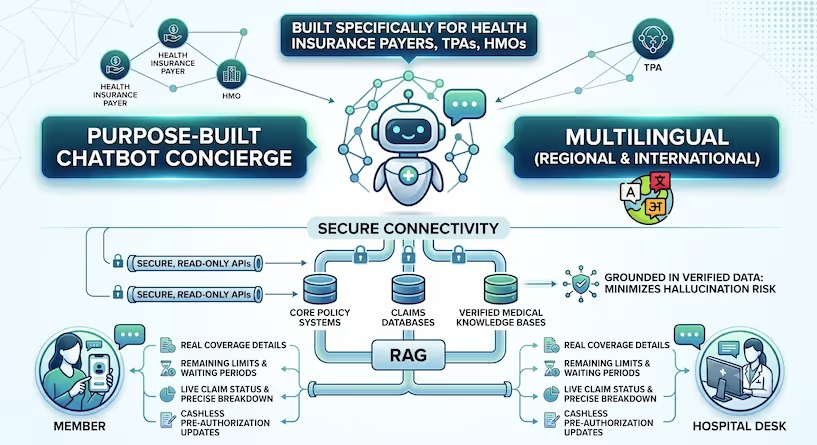
Rather than answering purely from what it learned during training, a RAG-based chatbot first retrieves the actual, relevant documents — the member's real policy, the real claims record, the real medical knowledge base — and then generates its answer grounded strictly in that retrieved material. The model isn't guessing from general knowledge; it's summarizing verified source data in natural language. Architectures built this way have been shown to meaningfully cut hallucination rates compared to open-ended generation, because the model has real facts to work from instead of patterns to extrapolate.
Secure, Read-Only Integration
A properly built system connects to core policy, claims, and medical knowledge systems through authenticated, read-only APIs — meaning the chatbot can look up and report real, live data (a member's actual remaining benefit limit, the real status of a submitted claim) without ever having write access to sensitive records. This keeps both the answers accurate and the underlying data secure.
Multi-Lingual Understanding
Because the underlying model works with natural language rather than fixed scripts, the same grounded, RAG-based approach extends naturally across languages — a member can ask the same question in different regional or international languages and receive an equally accurate, equally grounded answer, without maintaining a separate rule-based script for every language.
Guardrails and Scope
A production-grade system is also deliberately scoped — built to answer confidently within its actual knowledge domain (coverage, benefits, claims, pre-authorization status) and to hand off to a human agent for anything outside that scope, rather than generating a plausible-sounding answer to a question it has no grounded basis to answer.
How ZAAX's AI Chatbot Is Built to Solve This
This is exactly the architecture behind ZAAX Consulting's Multi-Lingual AI Chatbot Concierge, built specifically for health insurance payers, TPAs, and HMOs — not as a general-purpose customer service bot adapted to insurance, but as a purpose-built system for it.
The chatbot connects securely to core policy systems, claims databases, and verified medical knowledge bases through authenticated, read-only APIs, and answers exclusively from that retrieved, verified data through a RAG framework — the same grounding principle that reduces hallucination risk industry-wide, applied specifically to health insurance workflows. In practice, that means members and hospital desks get instant, accurate answers on real coverage details, remaining limits and waiting periods, live claim status with a precise breakdown, and cashless pre-authorization updates — in multiple regional and international languages, without the system inventing a plausible-sounding but wrong policy detail along the way.
The results are measurable rather than aspirational: the platform deflects up to 70% of routine call-center volume — the basic policy lookups and status checks that don't need a human — freeing support teams to focus entirely on the complex grievances that genuinely need one. It's available around the clock, and every answer stays strictly within the boundaries of verified policy and claims data, with member PII and policy access kept read-only throughout.
The Bottom Line
AI in customer-facing roles isn't going anywhere, and for good reason — done right, it genuinely improves response speed, availability, and consistency. But "done right" has a specific, non-negotiable meaning for regulated industries: grounded in real data, scoped to what it actually knows, and architected so that a wrong answer never reaches a customer in the first place.
That's the difference between a chatbot that's a genuine operational asset and one that's a liability waiting to surface in a compliance review or a customer complaint.